AI agent for business

An AI agent for your business, connected to your tools and team.

Answering a question, preparing a file or checking availability: we give the agent a precise role, authorized sources and a clear path when action is not possible.

Starting pointA new request

Understand. Verify. Transmit.

Authorized sourcesControlled actions
Business fileContext preserved
Human resumptionVisible exceptions
Journey illustration · conceptual interface

Your reality, our starting point

Context · Tools · Human takeover

For workshops, appointment services, sales teams, customer support, and B2B companies handling recurring requests.

An AI agent for business can interpret a request and use tools within a defined scope. Its value comes from the work it helps accomplish, not just its ability to converse. At Umbeli, we start from a concrete case: qualifying a request, retrieving information, or preparing an action. We determine available sources, authorized operations, and situations that must return to a person before connecting the agent to your systems.

From need to process

A request, a verification, then a reasoned response.

Explore the steps. This scenario illustrates an operation to adapt to your business.

  1. The client specifies their need. The agent collects necessary information without requesting unnecessary data for the path.

  2. The authorized tool queries the reference system. A lack of response does not become an invented availability.

  3. The agent announces only a confirmed result. If the situation is outside the scope, it forwards the request with its context.

Illustrative scenario

Qualification

Need
Requested service
Context
Necessary information
Limit
Defined mission

Request to verify

Example of a process, without reservation or data submission.

Choose a mission precise enough to be verified

An agent responsible for doing everything becomes difficult to evaluate. We choose a process with a beginning and an end: gathering the elements of a request, checking availability, or preparing a response. Real examples help define what a good response contains and what it should avoid. Out-of-scope questions, missing information, and ambiguous requests have an explicit follow-up.
Give access to the right information

Documents must be understandable, up to date, and authorized for the intended use. The project specifies their owner, update frequency, and information that must not be transmitted to the model. Variable data, such as availability or case status, are consulted in the reference system. The agent must not announce confirmation based on old text or assumption.

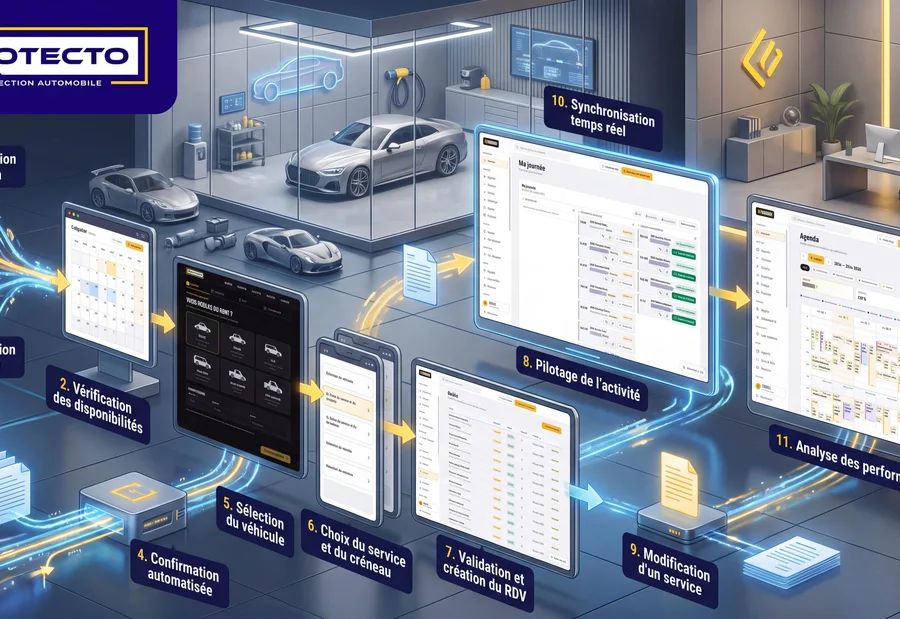
On the ground · Protecto Saguenay

The meeting starts at the client’s and continues at the workshop.

Protecto had to connect booking, request qualification, and workshop schedules. Fragmented management forced teams to synchronize information manually.

The mandate brought together clients, services, and schedules in a custom application. Online booking and the conversational agent rely on workshop availability. The client file becomes the passage point between request and operations.

Discover the project Protecto Saguenay
Presentation of the management platform · Protecto Saguenay

What takes shape together

An agent whose role, sources and limits are explicit.

A useful agent must know what to do, when to ask for confirmation and when to hand over. These rules become deliverables to review before entrusting a real journey.

A defined role

Covered requests, out-of-scope topics, and situations requiring a person.

The validation pointTest scenarios also include ambiguous requests and expected refusals.

Maintained sources

Reference documents, their responsible person, and how to update service responses.

The validation pointA response must be verifiable against a valid source; missing information calls for an explicit limit.

Tools with defined rights

Authorized readings and actions in your software, with necessary human validations.

The validation pointA sensitive action is tested with its permissions, confirmations, and failure cases.

An observable pilot

Test conversations, a log adapted to the need, and follow-up criteria after opening.

The validation pointYour team can identify a wrong response, fix its cause, and resume the conversation.

Separate preparation from action

Writing a draft, consulting a calendar and modifying a file do not have the same consequences. We define permissions for each tool, necessary validations and useful traces. A sensitive operation may require confirmation or human intervention. The success of a technical call must be verified before announcing the action is done. An error must lead to an explanation and a fallback solution.

Test ordinary cases and difficult situations

Tests include representative questions, missing information, and unavailable tools. We observe response quality, called actions, and how the agent transmits context to the team. Tests also verify that instructions in a document do not change its permissions. The pilot starts on a limited scope, with a person responsible for monitoring and corrections.

Organize follow-up after launch

Models, sources, and connected software evolve. Operation must be reexamined after significant changes. The budget distinguishes design, integrations, AI service usage, and maintenance. We plan necessary logs, their access, and retention per mandate. Human takeover must remain available, and your team must know how to suspend a function or correct inaccurate information.

Choose according to your situation

Assistant, automation, or agent capable of acting?

The level of autonomy must correspond to the need. Responses, rules, and actions in your software require different controls.

CriterionDocument assistantRule-based automationAgent with tools
RoleRespond from a reference corpus.Execute a defined sequence of steps.Understand a request and use authorized tools.
Good exampleFind a procedure or explain a service.Create a file after receiving a valid form.Qualify a request then consult a file or prepare an action.
Operating baseReliable documents, research, and response instructions.Structured data, planned conditions and processing.Sources, instructions, tools and limited access rights.
ControlsCheck the responses and anticipate missing information.Test exceptions, duplicates and recoveries after errors.Also test misinterpretations and confirmations before sensitive actions.
TrackingUpdate sources and review problematic responses.Monitor executions and maintain connections.Analyze conversations and actions, with human relay.

If a clear rule suffices, it often constitutes a simple starting point. The agent justifies itself when the request requires interpretation, with explicit limits and controlled actions.

Practical questions

Before starting

Can the agent replace our entire support team?

This is not the proposed starting point. We target recurring requests and plan for human intervention for exceptions. The pilot is used to verify the actual coverage of the need.

Can they send messages or modify a file?

Only if these actions are planned, authorized and tested. The project distinguishes drafts, consultations and writings. Confirmations and rights are adapted to the consequences of each operation.

How to avoid invented answers?

We reduce this risk with reliable sources, a precise scope, tests, and a fallback rule when information is missing. No model can promise a total absence of errors.

How much does its operation cost?

It depends on volume, models, calls to tools, and selected services. The quote separates development from usage fees and monitoring. A pilot helps observe actual consumption.

Your turn

And at your place, how does it go?

A client request, the tools you use, and what is blocking you today: this information helps us suggest a concrete starting point.

AI agent for business
Context · Tools · Human takeover

Let's talk about your need

Would you prefer to speak to someone? +1 819 609-8335